
A minimum viable product tests whether people want your idea before you build all of it. Here is what an MVP is and how to build one.

A minimum viable product, or MVP, is the simplest version of a product that real people can use. It exists to answer one question: do customers want this? A team builds it quickly, puts it in front of users, and learns from what they do before spending the rest of the budget.
Many founders read “minimum” as “smaller.” They take the full product they planned, remove a few features, and call the result an MVP. That version still takes months to build and tests nothing in particular. Startups most often fail because too few people need what they built, and a good MVP checks for that while changing course is still cheap.
A prototype tests an idea with your own team, and an MVP tests it with the market. The rest of this guide covers what goes into an MVP, what it costs, and the steps to build one.
What a Minimum Viable Product Actually Means
The name is easier to understand one word at a time. “Minimum” means the smallest set of features that can test your main assumption. For example, suppose you think restaurant owners would pay to automate payroll. The minimum is whatever lets one owner try it. Reporting and a mobile app can wait.
“Viable” means the product works well enough for someone to get real value from it. If the first version crashes or confuses people, you cannot tell why they left. They might not want the product, or it might simply not work. So the features you do build need to be solid enough for the test to mean something.
“Product” means real people can use it for a real purpose. A slide deck or a clickable mockup does not meet that standard.
People often mix up an MVP with a proof of concept and a prototype. A proof of concept checks whether the team can build something at all, and usually only the engineers see it. A prototype shows how the product will look and work. The team usually shows it to colleagues or a few test users. An MVP goes to real customers. In other words, a prototype checks the idea inside your company, and an MVP checks it with the market.
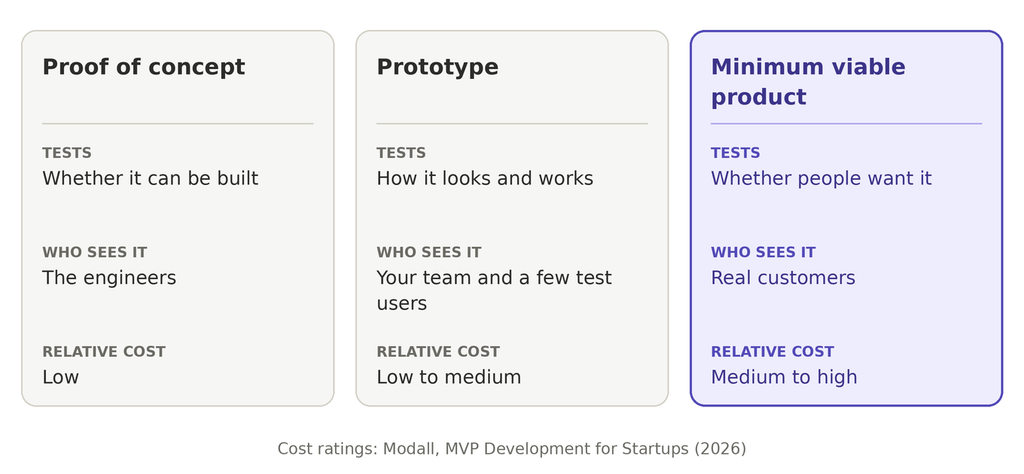
Cost rises in the same order. One 2026 comparison rates a proof of concept as low, a prototype as low to medium, and an MVP as medium to high. Some teams build a prototype first to settle the design. Others go straight to the MVP.
The Kinds of MVP and What They Cost
An MVP does not have to be software. Which kind you start with depends on what you still need to find out.
A page that tests demand
The cheapest way to test an idea is a single web page that describes the product and asks visitors to sign up. One 2026 guide puts a page like this at $0 to $500 and one to three days of work. Another quotes $2,000 to $8,000 over one to two weeks. Either way, if few people sign up, you have learned something about demand for a small fraction of the cost of a full build.
Doing it by hand
Some teams go a step further and deliver the service manually. Suppose you want to build payroll software for restaurants. You could run payroll for three or four owners in spreadsheets and see what they ask for. In that case, nothing gets built until you know what the software has to do.
A working version
Once demand looks real, the next step is a working product that does one job. No-code tools can handle the simpler versions. One 2026 guide estimates a no-code MVP at $5,000 to $15,000 over four to six weeks. It puts a custom-coded MVP with integrations at $30,000 to $60,000 over two to four months. Other guides run higher. One says most startups land between $40,000 and $80,000, and another calls 8 to 16 weeks a realistic timeline.
The spread comes from team location and scope. Most of these guides also come from agencies that sell MVP builds, so treat the figures as rough estimates. Still, the reason to spend the money is clear. According to one guide, full-scale development typically costs three to five times as much as the MVP, which makes a wrong guess far cheaper to catch early.
Choosing where to start
When the open question is whether anyone wants the product, start with the page. To find out whether you can deliver it well, do the work by hand first. Once both questions are settled, build the working version.
How to Build an MVP
The process is short, and most of the effort goes into deciding what to leave out.
Start with one problem
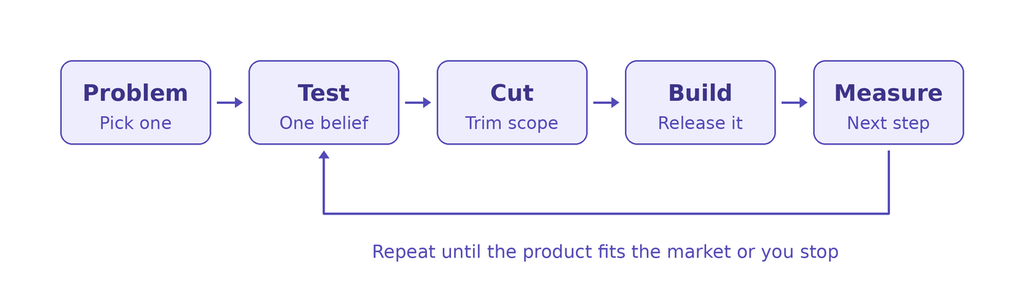
First, pick a problem and a group of people who have it. Talk to those people before you design anything. A good MVP solves one key problem for one audience. If you cannot describe the problem in a sentence, the product is not ready to be built.
Pick one assumption to test
Next, write down what you need to be true for the business to work. For example, you might believe that restaurant owners will pay a monthly fee to automate payroll. That belief becomes the test, and the MVP exists to confirm or disprove it. In other words, you build for the experiment and leave the finished product for later.
Cut the features
Then list every feature you have in mind and keep only the ones the test needs. This step is harder than it sounds, because every feature feels important to the person who thought of it. One guide calls cutting scope the most important part of the whole process. A useful check is to ask, for each feature, whether the test still works without it. If it does, remove the feature.
Build it and release it
After that, build the version you chose in the last section. If you go the working-product route, you can also choose a platform. Our blog on web apps versus mobile apps explains why a web app is usually the cheaper place to start. One 2026 guide gives product discovery one to two weeks and design two to three weeks before the build begins. Keep the team small so decisions stay fast.
Once it works, release it to a small group of real users. Before you do, decide what result would count as success, such as how many people sign up or how many come back in the second week. Without that number, any result can look like good news.
Measure, then decide
Finally, look at what the users did. Their behavior tells you more than their opinions. Based on the numbers, you can keep going, change the product, or stop. Teams repeat this loop until the product fits the market or turns out not to be viable, and stopping early costs far less than stopping after a full build.
Common Mistakes and What Comes Next
The most common mistake with a minimum viable product is building too much. A founder adds one more feature before launch, and then another, and the first version ends up taking as long as the full product would have. Scaling too early causes similar trouble. One roadmap guide describes premature scaling as spending on infrastructure, hiring, or marketing before the product has found its market.
After the release, the numbers tell you what to do next. If people use the minimum viable product and keep coming back, you can start planning the full version. Our blog on custom software development cost covers how to budget for that stage, and our guide to a software launch explains what to watch in the first 90 days.
If the numbers are weak, look at what users did before you decide anything. Sometimes a small change fixes the problem, and sometimes the idea has to change. In some cases, the right decision is to stop, and stopping costs far less after a minimum viable product than after a finished one, which is why many founders build one first.
Enjoyed this article?
Let’s talk about how a focused outsourcing partner can move your roadmap forward.